

Twenty years ago, seventy people drove to a cattle ranch in California to find out who among them was fittest. This July, the sport went back. The story of how it got there, and why it matters more than the leaderboard.
There was no music at the ranch. That was the first thing anyone noticed on the opening morning of this year's CrossFit Games. Sixty of the fittest people on the planet stood in a dusty field in Aromas, California, an hour south of San Jose, and the sound system stayed off. They wanted the morning to feel like it did the very first time, in 2007.
A Man Who Got Thrown Out of Gyms
The story starts with a former gymnast named Greg Glassman, who came to the sport as a boy recovering from polio and found in it a way to build a body that worked again. A bad dismount in high school took some of that back.
As an adult, he became a trainer in Southern California and then Santa Cruz, but he was not a popular one with gym owners. His sessions were loud. He had people sprinting, throwing things, dropping weights, racing each other for time. Then in the mid-nineties came a contract with the police department in Santa Cruz. Their fitness has to hold up in situations nobody scripts in advance, and coaching them sharpened an idea Glassman had for years.
The idea was not complicated. Most training at the time isolated muscles for appearance. Glassman thought fitness should be measured by capacity, across as many domains as possible. And the way to build that capacity was constantly varying functional movements, performed hard. Lifting, gymnastics, running, rowing. Things human bodies actually do.
He founded CrossFit with Lauren Jenai in 2000 and opened a gym in Santa Cruz the following year. Then he did the thing that changed everything, and it had nothing to do with training.
He put the workout online, every day, for free.

The Part Nobody Expected
CrossFit.com posted a “Workout of the Day” and charged nothing to read it. Glassman published his methodology in an open journal starting in 2002 and told people exactly how to do what he was doing.
For a while, nothing happened. Nobody outside his Santa Cruz gym seemed to be following along.
But then the comments started. A few at first, from people in garages and basements and military bases, posting their times under the day's workout. Soldiers found it. Police and firefighters found it. People who had no gym and no coach found it, because all they needed was the internet and something heavy.
Before long there were hundreds of comments under every workout, and something strange had formed: thousands of strangers, scattered across the world, doing the exact same hard thing on the exact same day and telling each other how it went.
Then two trainers in Seattle asked Glassman whether they could open a gym and use the name. He let them, and the affiliate model was born: not a franchise or a chain, but independently owned gyms paying a fee to fly the flag and otherwise running their own rooms their own way. There were 13 affiliates in 2005. There were more than 13,000 a decade later, and the number eventually crossed 15,000 worldwide.

Woodstock of Fitness
In early 2007, a CrossFit trainer named Dave Castro invited Glassman out to his family's cattle ranch in Aromas. Glassman looked at the open ground and suggested they throw what he called a Woodstock of Fitness. Get the community together. Bring a tent. See who is actually fit.
It happened over two days at the end of June. There was no qualifying process, because there was nothing to qualify for. Anyone who wanted to compete signed up and drove out. About 70 athletes did, and roughly 150 spectators came to watch, mostly the athletes’ families.
The workouts were pulled at random from a hopper, a rotating metal cylinder loaded with balls marked with different movements. Castro turned it, the balls came out, and that was the workout. Nobody could train for it, which was the entire philosophy made physical: prepare for the unknown, because life does not send an itinerary.
The opening event: a 1,000-meter row, then five rounds of 25 pull-ups and seven push jerks. After that, a trail run through the hills. After that, a test of raw strength.
James Fitzgerald of Canada won the men's title. Jolie Gentry of California won the women's. They each took home $500. From the very first year, CrossFit paid its male and female champions exactly the same. It has done so every year since.
The following summer they capped entry at 300 people, first come, first served. That was the last year you could simply show up.

What Happens When Something Gets Big
The Games left the ranch and moved into stadiums. Carson, California. Madison, Wisconsin. Fort Worth. Albany. Sponsors arrived, then bigger sponsors. ESPN aired it. In 2011 the sport launched the Open, an online qualifier anyone in the world could enter from their local gym, and hundreds of thousands of ordinary people started measuring themselves against the best on earth using the same three workouts.
Growth like that always costs something. The sport got professionalized. Athletes started specializing. The people who had loved the backyard barbecue watched it turn into a broadcast product with a stage and a scoreboard.
And in 2020, the founder exited. Glassman resigned in June of that year after posting a callous comment about the murder of George Floyd. Warranted backlash ensued. Gyms disaffiliated within days. Sponsors walked. He sold the company before the summer was out.
Although many gyms took the CrossFit name off the door, they kept their members, kept their 6 a.m. class, and carried on. The community turned out to be a separate thing from the man who started it and the brand he sold. It had its own life, in ten thousand strip malls and converted garages, and it did not need permission to continue.

Then Hyrox Arrived
Anyone paying attention to fitness in the last few years has watched Hyrox go vertical. It launched in 2017 into a world CrossFit had already built, and it has grown faster than CrossFit ever did. More than 750,000 people raced it last year, across dozens of countries, and races now sell out in minutes.
The formats explain the difference completely.
Hyrox is the same everywhere on earth. Eight one-kilometer runs, each one followed by a fixed station: wall balls, sled push, sled pull, burpee broad jumps, rowing, farmers carry, lunges. Same order, same distances, Berlin or Chicago or Singapore. You can train for it with precision, book a flight, and compare your time to a friend who raced it last spring on another continent. It asks for no gymnastics, no barbell skill, no learning curve that takes a year.
CrossFit refuses to tell you what is coming. The athletes in San Jose did not know some of their events until minutes before they performed them. That is not an oversight, it is the founding premise, and it is also a barrier. Learning a muscle-up can take months. Learning to lift safely takes a coach.
What Critics Say
CrossFit has spent years absorbing criticism from some in the industry, and a fair amount of it lands.
Workouts come with a prescribed weight, and completing one as written can carry status. That design choice puts quiet pressure on newcomers to load a bar they have no business loading, in front of an audience, against a clock. Good gyms work hard to defuse it.
Then there is the criticism that a 2-day certification for coaching is not nearly enough. However, many coaches do build far past that minimum, stacking specialty certifications and degrees and years of practice on top.
While there is risk of injury in CrossFit, the danger in any physical activity comes from intensity arriving before instruction and technique. The methodology's stated hierarchy puts mechanics first, then consistency, and only then intensity.
Going Back to the Dirt
Which brings us to this July at the ranch.
For the twentieth anniversary, CrossFit sent the athletes back to Aromas, to the same hills, and opened the competition with the original 2007 workout: the row, the pull-ups, the push jerks. The hopper that produced it was wheeled out for the ceremony, and it was not a replica. It was the same metal cylinder that turned on that ranch nearly two decades ago.
Then everyone drove up the road to the SAP Center in San Jose, an NHL arena, for three days in front of a full house. That journey, from a dusty field to a sold-out arena and back again in the space of a week, is the clearest picture anyone could draw of what this sport is now. It is a professional spectacle that keeps checking whether it still recognizes itself.
What We Are Actually Buying Into
The luxury press has noticed the fitness racing boom and mostly framed it as a new status achievement. A finish line you cannot purchase. A flex that requires sweat and three-hundred-dollar shoes.
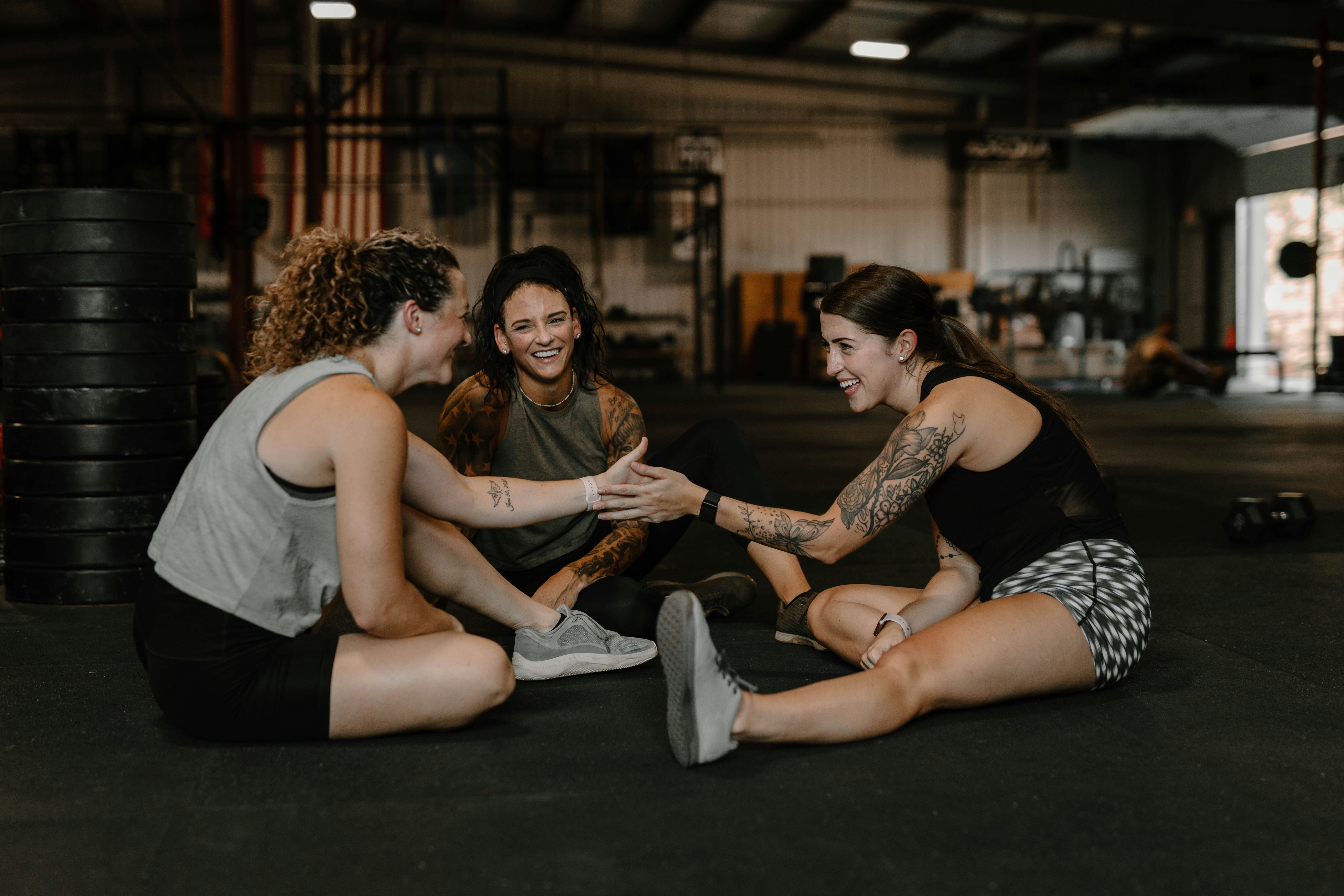
But there is a deeper reason many start CrossFit or Hyrox. They don’t go back to a gym for four years just because of the programming. They go back because at 6 a.m. on a Tuesday there is a room where somebody notices whether they showed up. They go back because a retired teacher and a nurse and a twenty-four-year-old carpenter are all struggling through the same set and nobody there cares what any of them does for a living.
Loneliness is the health crisis nobody sells supplements for. It shortens lives. It is measurable in the body. And what a functional fitness gym quietly does, underneath all the chalk and the leaderboards, is put strangers in a room at a fixed time, give them a hard thing to do together, and make their absence noticeable.
That is the product. Twenty years ago, seventy people drove out to a cattle ranch because a man on the internet suggested they get together and find out how fit they were. The fitness was the reason they came. It was not the reason they stayed.

The 2026 CrossFit Games were held July 22 through 26 in Aromas and San Jose, California. Full results are at games.crossfit.com.
A Note on Safety
We make no argument against hard training. We do want to promote principles that apply to any movement practice, whether a CrossFit class, a Hyrox race, a Sunday run club, a reformer studio, or a heavy day alone in a garage.
Learn the movement before you load it or race it. A moderate weight moved well builds more than a heavy one moved badly, and it is the only version that is still available to you in ten years.
Scale without apology. Every workout is designed to be adjusted. The athletes who have been at it longest tend to scale the most, because experience teaches you to hear what your body is reporting rather than argue with it.
Tell your coach about injuries, pregnancies, and conditions before the class starts, not halfway through it. A good one will already be asking.
Eat and drink to support the work. Training hard on insufficient food or water is not discipline, it is a way to arrive at an injury faster. Hydration matters especially in heat, and the appetite that follows real training is information, not a failure of willpower.
Treat rest as part of the program. Adaptation happens between sessions, not during them.
If something hurts in a way that feels sharp, structural, or wrong, stop. Anyone who tells you otherwise is not coaching you.