
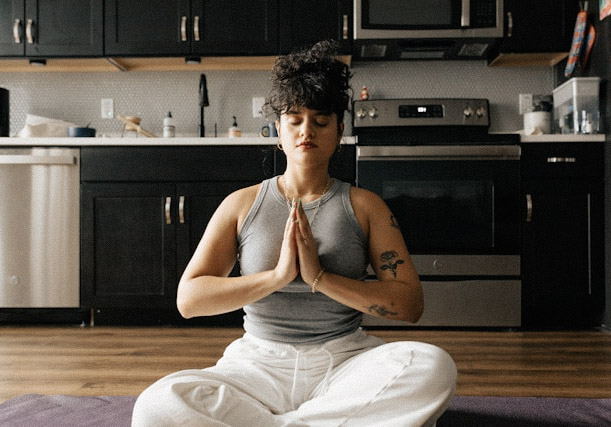
You are a few minutes into pigeon pose when something wells up that has nothing to do with your hips. Or you are deep into a high intensity spin class, the music carrying you, and somewhere between the movement and the breath something shifts, your eyes well up and you are not entirely sure why. It might be grief. It might be something that does not have a name. It might be the first moment in weeks that you have actually stopped.
If this has ever happened to you, you probably remember it. And you may have spent some time afterward wondering what it meant, or whether something was wrong, or whether you are simply a person who cries at workout classes now. The real answer is that the body was doing something it is very good at, and that it chose a moment of movement to finally do it.
What the Body Actually Stores
The conventional understanding of stress and trauma treats them primarily as psychological phenomena: events that are processed by the mind, stored as memory, and addressed through language. But a significant body of research in somatic psychology and neuroscience over the past three decades has complicated that picture considerably.
The somatic approach, developed through the work of researchers and clinicians including Peter Levine and Bessel van der Kolk, proposes that unprocessed stress, grief, and difficult experience are not stored solely as memories but as physical patterns held in the body itself. Tension in the muscles, constriction in the breath, chronic activation of the nervous system's threat response. The body, in other words, keeps the score in the most literal sense, and it keeps it in the tissue. This means that the pathway to releasing what the body holds is not always through the mind.
Hip Openers and the Places We Hold Things
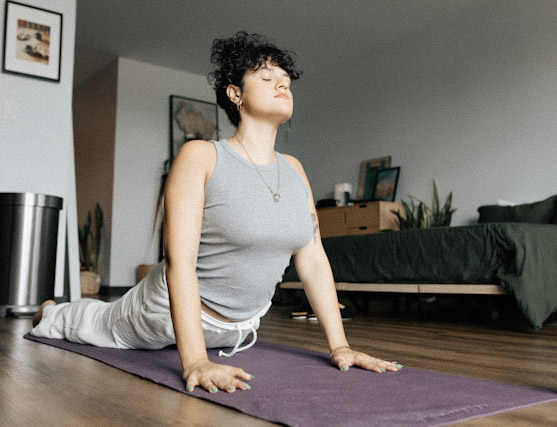
Ask anyone who has practiced yoga seriously for long enough about hip openers and you will hear some version of the same story. The long holds in pigeon pose, lizard, or yin-style forward folds have a reputation, sometimes a warning attached to them in class, for bringing up unexpected emotion. Students cry. Students feel a sudden wave of something heavy or something light. The sensation is real enough that it has become a commonplace in yoga culture, and the science behind it is more grounded than you might expect.
The hips are a primary site of chronic tension in the body, partly because they are central to the fight-or-flight response. When the nervous system perceives threat, the hip flexors engage as part of the body's preparation to run or brace for impact. In contemporary life, where stressors are usually not physical and the nervous system activates without the physical discharge that resolves the response, this tension accumulates and can be held in the tissue long after the stressor has passed.
Research in the field of somatic experience suggests that this kind of physical release, when it occurs in a safe context with appropriate awareness, can be genuinely therapeutic rather than merely cathartic. The distinction matters: catharsis alone does not always produce integration. But movement that combines physical release with breath and intentional awareness seems to create the conditions for the nervous system to actually complete the stress response cycle rather than just discharge energy temporarily.
High-Intensity Movement and Physical Release
The same mechanism operates through a different pathway in high-intensity exercise. Sustained, vigorous movement elevates cortisol, the body's primary stress hormone, as part of normal exertion. When the movement stops, cortisol drops rapidly, and this drop-off can create an emotional window in which the nervous system, already activated and then suddenly released, surfaces feelings that were being held below the threshold of ordinary awareness.
This is part of why runners describe emotional clarity after long runs, why the cooldown after an intense class can feel more emotionally charged than the class itself, and why certain movement practices that combine intensity with breath and repetition, like yoga, seem to produce emotional release with a consistency that feels intentional rather than accidental.
The Class by Taryn Toomey, in NYC and LA, has built an entire methodology around this understanding, combining high-intensity repetitive movement with breath cues, sound, and explicit permission for the body to express rather than suppress. It is one of the more developed examples of a practice that takes the somatic movement phenomenon seriously as a design principle rather than treating it as a side effect. People cry in almost every class, not as an outlier but as a kind of arrival, the body saying something it has been holding. That it happens in the context of a group fitness class in Tribeca at six in the morning is strange and clarifying at the same time.
But The Class is not the only place this happens. It happens in a long yin class at the studio down the street, in the cooldown after a track workout, in a dance class when a particular song comes on. The practice does not have to be purpose-built for somatic release in order to produce it.
Our Bodies and Our Environment
There is a related thread worth pulling on here, which is what researchers have started calling green exercise: physical movement that takes place in natural environments. A multi-study analysis published in the International Journal of Environmental Health Research found that both exercise and exposure to natural scenes independently improved self-esteem and mood, and that the combination produced a clear additive effect. A more recent systematic review found that green exercise reduces stress, depression, and blood pressure while increasing mood and wellbeing across a wide range of populations, with particularly pronounced benefits for people already experiencing mental health challenges. Part of this is the physiological effect of natural environments on the nervous system: lower cortisol, reduced activity in the brain's rumination network, the same mechanisms behind shinrin-yoku and forest bathing. But part of it is something subtler: that moving through a landscape, especially one with depth and horizon and the kind of sensory richness that a screen cannot replicate, invites a quality of presence that indoor environments rarely do.
Ecotherapists, practitioners who work at the intersection of mental health and the natural world, have long argued that being in the presence of a natural environment is itself therapeutic, that the body in nature is being reminded, on a level beneath language, that it belongs somewhere. The emotional release that sometimes follows a long trail run or an ocean swim is not entirely separate from the release that happens in pigeon pose or a cathartic group fitness class. It is the same physiological intelligence, finding a different trigger switch.
What to Do With It When It Happens
The instinct, when emotion surfaces unexpectedly in a movement context, is often to suppress it, to be embarrassed, to redirect. Most gym culture actively discourages any visible emotional response that is not enthusiasm. Somatic practitioners generally suggest the opposite: that when physical movement creates an opening for emotional release, the most useful thing is to let it complete rather than shut it down. Not to perform it, not to analyze it mid-class, but simply to stay with the breath, allow the sensation to move through, and not treat it as a problem to be managed.
The body's capacity to discharge what it carries through physical movement is one of its least-utilized resources in a culture that routes most emotional processing through the mind, and buries the rest of it. Movement, particularly the sustained, rhythmic, and intentional kind, has been doing this work for as long as humans have moved together, in ritual, in dance, in the physical labor that once structured daily life. The yoga class and the 6am workout are recent formats for something much older.
If this happens to you, the most useful thing to know is this: your body was not malfunctioning. It was doing something it inherently knows how to do. It just finally had enough space to do it.

Why It Matters in May
May is Mental Health Awareness Month, and the research on the connection between exercise and mental health is extensive and largely uncontroversial at this point. Physical movement reduces cortisol, supports serotonin and endorphin regulation, and builds the kind of nervous system resilience that psychological flexibility depends on.
That distinction between a general benefit and a specific practice is where the most interesting work in the fitness-mental health space is happening right now, and The Class has been doing it quietly in a white room in Tribeca for over a decade. The fact that people keep showing up at six in the morning is probably the most honest review available.